

Insights · The Cost of Compute · Part 1
Why Open-Source Is Bad News for Big AI
While tech giants race to build ever-larger and more expensive AI models, businesses are discovering cheaper and more efficient open-source alternatives.
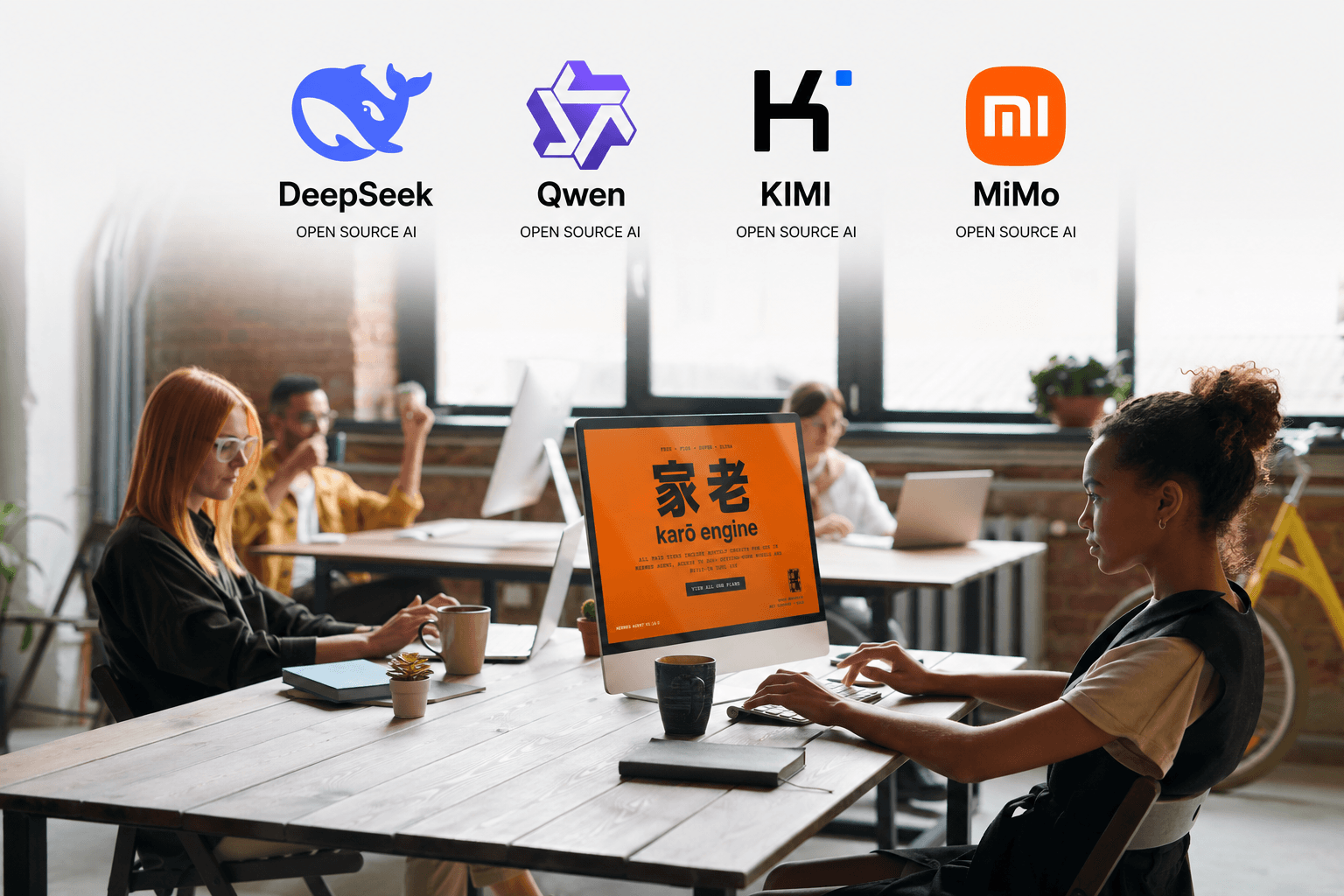
Marketing from the big labs (OpenAI, Anthropic, Google) would have you believe they're the only AI available to you: enormous, expensive, and American. Tokenmaxxing, bro! Pay whatever it costs to keep up.
That story's never been true, though, and Big AI is now under pressure as customers look for open-source alternatives that cost less, carry a smaller environmental footprint, match the big models on most business tasks, and keep your data out of a tech giant's hands.
The shift
Open-Source vs Big AI
- Open-source AI models have become good enough to handle the overwhelming majority of real business work at a fraction of frontier-model cost, and they're more controllable, privacy-preserving, and have less of an environmental footprint. Importantly, you choose where to run them. You're not locked in to sending your data to another country if you don't want to.
- The frontier labs' business model depends on you consuming more of their most expensive product. As cheaper, capable alternatives arrive, that model is wobbling. The cure for the industry’s spending problem is, in their own analysts’ words, "not good for OpenAI."
If you run a lean operation, like a solo consultancy, a small agency, a family business, or a technical micro-startup, the open-source AI alternatives that are creating so much pressure on the big frontier labs work in your favour.
Sticker shock
The practical solution
The leading frontier labs, the makers of the largest closed AI models, earn more when you run more tokens through their systems. Their revenue scales with your consumption. That works beautifully if everyone believes bigger is always better and price is no object. Price is always an object, though.
Through late 2025 and into 2026, more than half of planned AI data-centre projects were reported delayed or cancelled. Enterprises that treated AI spend as unlimited got a shock: Uber's leadership reported burning through its entire 2026 AI budget in roughly four months, then publicly questioned the return on investment. “AI sticker shock” became a real line item in real boardrooms.
The industry's response to that shock is practical: use less of the expensive models, routing routine work to capable, cost-effective open-source alternatives instead. CNBC framed the solution bluntly as “not good for OpenAI.” When saving money means consuming less of a company's core product, that company's growth is in question.
Good enough
Open-source is the story
The unspoken assumption behind premium pricing is that you need the smartest possible model for everything. You don't.
The vast majority of day-to-day business work, like data analysis, drafting, summarising, classification, scheduling logic, routine code, and standardized customer replies, does not require frontier-level intelligence. It requires reliable intelligence. And cheaper open-source models clear it comfortably.
Scott Wu, CEO of the agentic coding startup Cognition, put the proportion plainly: “50% of tasks, 60, 70% of tasks, they actually don't need the absolute smartest intelligence.” His example is hard to argue with. Ask any model who the third U.S. president was and every one of them returns Thomas Jefferson. You don't need to hire a tenured professor to answer that, and you certainly do not need to pay professor rates for it on every query.
“Across the board, open models can run 10 to 50 times cheaper than the biggest frontier systems.”
The cost gap is not subtle. Running the same coding workload on a top-tier model has been reported to cost roughly 19 times more than running it on the Chinese open-source model DeepSeek. Across the board, open models can run 10 to 50 times cheaper than the biggest frontier systems. For routine work, you are often paying a large premium for a difference your customers will never notice.
The competitive map
Why the threat to Big AI is coming out of China
The most capable open models are coming from China, and that's reshaping the competitive map.
The structural problem for American open source is a broken business model. A U.S. lab pays the full cost of research and training, releases the model openly, and then anyone can serve that same model at better margins, because they skipped the R&D bill. As analyst Matthew Berman put it, U.S. open-source AI is “almost certainly doomed” without a way to pay for itself.
China is playing a different game. Some of it is state support for chosen players, but the deeper driver is cultural. Chinese research and engineering have a long-standing habit of developing and sharing AI knowledge in the open. As NVIDIA's Jensen Huang describes it, a given lab's engineers tend to have siblings, friends, and schoolmates working at rival labs, so knowledge travels fast and there is little instinct to keep it hidden. Publishing the work openly is simply the default. The result is a flood of capable, openly licensed models, and a release cadence that is hard to match. By one venture-firm estimate, U.S. open frontier models ship roughly every eight months; comparable Chinese models ship every seven weeks. That's a fivefold gap in how fast the open baseline improves.
The market has noticed. DeepSeek made a temporary 75% price cut on its V4 model permanent, specifically to pull in business migrating off frontier models. On Hugging Face, the platform developers use to share models, Chinese models went from about 1.2% of downloads at the end of 2024 to roughly 30% by early 2026, and Alibaba's Qwen family overtook Meta's Llama in cumulative downloads.
There is a real cautionary tale in here, too. Perplexity, a search product built on models it does not own, is structurally squeezed: it must pay full third-party token costs, so when the labs raise prices, it has to as well. Anyone reselling someone else's tokens inherits someone else's cost problem.
“If we don't activate, we'll be buyers, not sellers.”
Huang himself does not sugar-coat the stakes: U.S. frontier models lead by perhaps six months, but China is “way ahead on open source.”
The five-layer cake
China's advantages
The lead in open source is not an accident. It rests on structural advantages Huang describes as a “five-layer cake”:
- Talent and culture. Underneath everything sits a deep talent base: by various counts, around half the world's AI researchers are Chinese, China published roughly 70% of last year's AI patents, and a culture of open knowledge-sharing makes releasing models the default rather than the exception.
- Energy. China generates roughly twice the U.S. total and is still growing fast, while Western grids are the binding constraint. Chip firms there also receive steep energy discounts.
- Infrastructure. A U.S. data centre can take around three years from ground to standup, while China's build velocity is in another category entirely.
- Models. Of the roughly 1.4 million models in circulation, most are open source, and China leads that field.
- Adoption. Surveys suggest about 80% of people in China expect AI to do more good than harm (the reverse of Western sentiment).
Less is more
Constraints = efficiency
The constraints put on China actually benefit all. U.S. export controls block the most powerful chips from reaching Chinese labs. So those labs were forced to find efficiency: algorithmic “unlocks” that squeeze more capability out of lesser hardware.
That pressure produced genuinely leaner models. DeepSeek's recent work on “thinking with visual primitives,” for example, reportedly uses around 90% fewer visual tokens than frontier approaches while matching or beating them, a genuine “less is more” result. Leaner models mean lower inference cost, which means cheaper output for you.
The differences are immediately apparent. American frontier models have been getting more expensive, by some accounts nearly twice as costly per version, and have been described candidly as “very powerful but very inefficient.” Efficiency built under constraint is now a feature you can buy.
Values & economics
A smaller footprint
For many small businesses, there is also a dimension of values and ethics, and it happens to align with the economics.
Open-source models run locally or in a region of your choice, use a fraction of the compute per task compared with reaching for the largest frontier model every time. Smaller footprint, less waste. For a crew who resists burning valuable resources, using only the compute the job actually requires is both cheaper and lighter. Far from a sacrifice, that is simply good operating practice.
The Big AI buildout is a heavy draw on resources. Data centres consume on the order of 2% of global electricity, much of it still from fossil fuels; in 2025, more was reportedly spent on data centres than on U.S. housing construction. And there are signs the demand was overestimated. By one Goldman estimate, far less data-centre capacity was actually operational than the headline numbers implied.
Operational sovereignty
An advantage for small teams
Put it together and the advantage tilts towards the disciplined operator: lower cost, a much lighter environmental footprint, real control, data privacy, no lock-in to a single vendor, and the ability to run systems yourself. That's operational sovereignty and freedom for a small, agile crew.
You don't have to take it on faith, because the giants are already doing it quietly. The pattern shows up across well-known American companies:
- Shopify replaced a single-shot pipeline built on a frontier model, which could only cover 13% of its merchants, with a multi-agent system running a self-hosted open model. The result, by its own engineers’ account: full coverage, roughly double the quality, and a 75-fold reduction in per-unit inference cost.
- Airbnb runs its customer-service agent heavily on an open model its CEO calls "very good, fast, and cheap," and one that, unlike a closed API, can be fine-tuned to its own needs.
- Cursor, a coding tool marketed as frontier-grade, was found to be running on an open model out of China.
- Exa swaps closed models for self-hosted open ones the moment the closed option proves "too expensive or too slow."
One point worth making: self-hosting an open model means the model runs where you want it to. A model run locally keeps your data local. You have control of what touches your data.
The lesson for a small business is simple. If the biggest names in tech are quietly self-hosting open-source models to win on cost and control, a small team can run the same play.
The playbook
Is adopting open-source right for your business?
Say your business has adopted AI and you agree with all of this. You'd rather not hand a tech giant a blank cheque or your data. What does that look like in practical terms?
- Find out where you are overpaying. List the AI-assisted work your business already runs. Most of it will be everyday work that a cheaper model handles just as well.
- Route every task to the right tier. The single most effective habit is model routing: directing each job to the cheapest model that can do it well, rather than sending everything to one expensive model. A simple three-tier setup covers most businesses:
- Tier 1, the hard 5%. A frontier model stays in reserve for genuinely novel reasoning and your trickiest edge cases, the only work that truly justifies premium rates.
- Tier 2, the middle ground. A mid-sized, capable model takes on nuanced writing, longer reasoning, and routine code that needs a bit more judgement.
- Tier 3, everyday volume. Small, cheap, often self-hosted open models handle the bulk of your work: bulk analysis, classification, simple questions. This is where most of your tasks live and where most of your savings come from.
- Prove it on one task first. Before committing, take a single routine job and run it on a Tier 3 model alongside your current one. Compare the output honestly. In most cases the difference is invisible to your customers and obvious on your bill. A gateway like OpenRouter makes this easy: one account gives you pay-as-you-go access to hundreds of models, so you can compare prices and swap between them without rewiring anything. Two caveats worth knowing. Your prompts pass through a third party on their way to each provider, so it is not the right home for sensitive data, that still belongs on a model you self-host. And an off-the-shelf gateway only routes between models, whereas a custom-built routing system can weigh your own rules, costs, and data boundaries for far more flexibility.
- Protect your sensitive data. For anything involving client records or proprietary information, look at open models you can self-host, locally or in your own region, so the data never leaves your control.
- Avoid getting locked in. Build your setup so you can swap models as prices and quality shift. The whole point of this moment is agility, and agility means never being trapped with a single supplier.
This is how we build at Motiv. Every agent we ship is designed around model routing from the start, because it is the most dependable way to keep compute costs predictable and avoid surprise bills.
Start here
Open-source models worth knowing
A few of the leading open-weight model families you can try, compare, or self-host today:
DeepSeek
The Chinese lab whose low-cost, high-efficiency models set off the price war. Strong at coding and reasoning at a fraction of frontier-model cost.
Qwen
Alibaba's open model family that overtook Meta's Llama in downloads. Versatile, fine-tunable, and widely self-hosted in production.
Kimi 2.6
Moonshot AI's open model, known for very large context windows and native multi-agent use. Quietly powers tools marketed as frontier-grade.
MiMo
Xiaomi's compact, efficiency-first open model family, built for cost-sensitive and on-device workloads.
GLM 5.2
Zhipu AI's open model line: a popular, capable workhorse for routing the high volume of everyday business tasks cheaply.
FAQ
Frequently asked questions
Is open-source AI good enough for business?+
For the large majority of business tasks, like drafting, summarising, classification, routine code, and customer support, the answer is yes. Open models now perform comparably to premium frontier models on routine work at a fraction of the cost. Frontier models still lead on the hardest, most novel problems, so the practical approach is to match the model to the task rather than defaulting to the most expensive option.
Are frontier AI models worth the cost for small businesses?+
Sometimes, for genuinely hard reasoning or specialised work. But for everyday operations, paying frontier rates is usually overspending. The same workload can cost many times more on a top-tier model than on a capable open one, with no difference your customers would notice.
What's the difference between open-source and closed AI models?+
Closed models (such as the flagship OpenAI or Anthropic systems) are accessed only through the provider's API, so you rent capability and your usage scales your bill. Open-source or open-weight models can be downloaded, fine-tuned, and run on your own infrastructure, which lowers cost, improves privacy, and avoids vendor lock-in.
Does using a Chinese open-source model mean sending my data to China?+
No, not necessarily. Open-source models can be downloaded and hosted anywhere, so you retain control over where your data goes, unlike big, black-box frontier models based in the United States. Using a model developed abroad is not the same as transmitting your data abroad.
References
Sources
Figures and quotes above are drawn from the reporting and analysis below. Several are forward-dated, 2026-era estimates and are presented as reported by their original sources.
- Deirdre Bosa, “AI model routing: How Chinese models are taking over AI usage,” CNBC TechCheck, June 8, 2026.
- Deirdre Bosa, “The Fix For AI's Spending Problem Is Not Good For OpenAI And Anthropic,” CNBC, June 5, 2026.
- Deirdre Bosa, “Tokens or Humans? The New AI Cost Trade-Off Reshaping Corporate Budgets,” CNBC, May 29, 2026.
- “The AI Token Shortage Begins,” The AI Daily Brief (Nathaniel Whittemore), June 1, 2026.
- “Why U.S. Companies Are Quietly Being Run On Chinese AI,” BetterWay, June 8, 2026.
- “Two Loops: How China's Open AI Strategy Reinforces Its Industrial Dominance,” U.S.-China Economic and Security Review Commission (USCC), March 2026. Read the report.
- “DeepSeek Is a Problem,” Matthew Berman, April 29, 2026.
- “Can't Replace China: NVIDIA CEO Warns of China's Quick Progress,” Mint (Jensen Huang interview), December 3, 2025.
- “Why China Is Successful in Tech,” Jensen Huang with Lex Fridman, March 23, 2026.
- “DeepSeek's New AI Is A Game Changer,” Two Minute Papers (Dr. Károly Zsolnai-Fehér), May 21, 2026.
- “Why Tech Companies Are Quietly Cancelling AI Data Centers,” Economy Media, May 22, 2026.
- “Perplexity Is Collapsing…,” Mondo Startups, May 22, 2026.
Mike Mara is the CEO and Chief Operations Officer of Motiv Creative Labs Inc., a Victoria, BC creative development studio building high-performance, AI-ready websites and custom apps for small and medium-sized businesses across British Columbia.
Ready to talk?
Want AI that keeps your compute costs predictable?
We build AI agents and automations around smart model routing, so your business gets capable results without the frontier-model bill.